 Holiday Routes
Driving in Italy: motorway tolls, ZTL zones and rules for a smooth trip
On this page
Planning on driving in Italy for your next European holiday? Understanding how motorway toll barriers operate, keeping clear of historic centre traffic restrictions, and carrying the required safety kit will keep your journey smooth, relaxed, and fine-free.
Motorway tolls on the Italian autostrada network
Unlike neighbouring countries that rely on windscreen vignettes, Italy uses a traditional ticket-and-barrier system across its motorway network. When you enter an autostrada managed by Autostrade per l'Italia, you collect a physical paper ticket at the entrance barrier. You must keep this ticket safe inside your vehicle until you leave the motorway.
As you approach an exit toll plaza, look up at the overhead signs above each lane. You will encounter several distinct lanes:
- Yellow lanes marked Telepass: Reserved strictly for drivers with an active transponder device. Do not enter these lanes unless your car or rental has a registered unit installed, as passing through without one will trigger an unpaid toll alert.
- Blue or yellow lanes marked Carte: Designed for self-service payment by contactless credit or debit card (Visa or Mastercard). These lanes are typically quick, straightforward, and painless.
- White lanes with cash symbols: Lanes that accept coins and banknotes, either through an automated machine or with a human toll attendant.
Insert your entry ticket into the exit machine first, followed by your contactless card. Toll systems and fee structures across different motorway operators can vary, so check the official site before you go at autostrade.it.
Understanding ZTL zones in historic city centres
The most common surprise for international motorists in Italy is the Zona a Traffico Limitato (ZTL). These restricted-traffic areas protect fragile historic centres, reduce congestion, and lower emissions in cities across the country.
Key cities with active ZTL systems include:
- Florence: Covers almost the entire historic core around the Duomo and the Arno River.
- Rome: Extensive daylight and night-time ZTL zones covering the central Centro Storico, Trastevere, and San Lorenzo.
- Milan (Area C): A congestion and low-emission zone operating across the central ring.
- Bologna and Pisa: Strict central access controls monitored continuously by automated cameras.
Driving past a ZTL sign into an unauthorised historic district triggers an automated camera that logs your number plate instantly. Each separate entry triggers an individual fine. If your hotel is located within a ZTL, contact them in advance or hand your licence plate number to the front desk immediately upon arrival. Hotel staff can enter your vehicle into the municipal system for a temporary loading transit permit. Because local municipal rules differ by town, consult the relevant city portal, such as comune.fi.it/ztl, and check the official site before you go.
Mandatory safety equipment to carry in your vehicle
Before crossing the border into Italy, verify that your car carries the legally required emergency equipment. Italian traffic regulations specify precise items that must be inside the passenger cabin rather than stowed away under heavy luggage.
- High-visibility reflective vests (EN ISO 20471): Italy requires one reflective vest per passenger. Crucially, these vests must be stored within arm's reach inside the passenger cabin—such as in the door pockets or glove box—so that you can put them on before stepping onto the roadway. Keeping them locked in the boot is not compliant.
- Warning triangle (ECE R27): Every vehicle must carry at least one certified hazard warning triangle to place behind the car in case of a breakdown or puncture.
Requirements vary across Europe; for example, neighbouring Austria and Switzerland also require one warning triangle, while Spain and Romania require two. Reviewing the rules beforehand prevents unexpected roadside stops. For broader cross-border advice on packing and safety, see our guide on driving in Austria this winter.
Planning tip: If you are planning an Italian journey with multiple stopovers, choose hotels with dedicated private parking just outside old city walls. This eliminates ZTL stress and leaves you free to explore pedestrian streets on foot.
Emergency numbers and roadside breakdown assistance
In the event of an accident or unexpected medical issue while driving in Italy, knowing who to call makes all the difference:
- 112 (Universal EU Emergency): Connects directly to emergency dispatch across all EU member states. It is completely free and works on mobile phones even without a SIM card or active roaming package.
- 113: Italian State Police (Polizia di Stato).
- 118: Medical emergencies and ambulance dispatch (Emergenza Sanitaria).
- ACI Roadside Assistance (Automobile Club d'Italia): Dial 803 116 from an Italian phone, or +39 02 66 165 116 from an international or mobile number.
Keep these numbers noted in your glove box or saved on your mobile device before heading onto the road.
How Holiday Routes helps you prepare for Italian roads
When you map out a journey through Italy on Holiday Routes, the app tracks every national border crossing on your itinerary. You do not have to search through disparate government forums to find out whether you need a vignette, a toll ticket, or specific reflective gear.
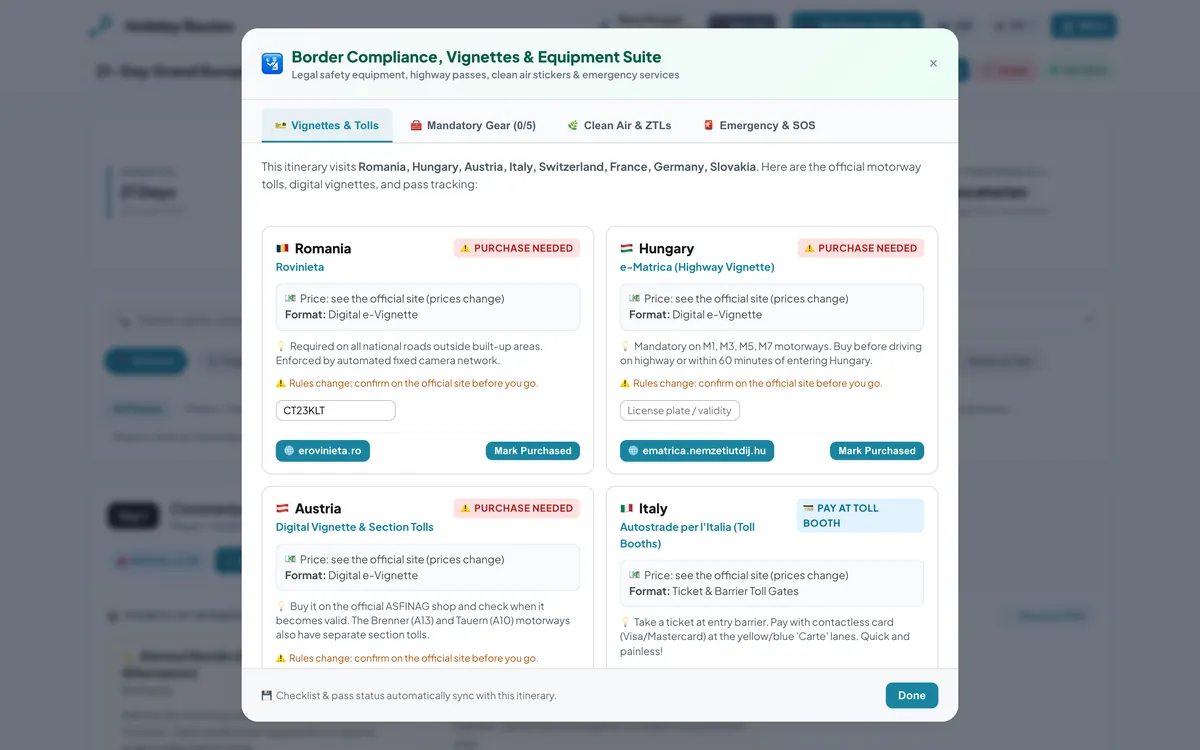
Opening the Borders & vignettes window shows you the motorway payment format, direct links to official toll portals like Autostrade per l'Italia, urban restriction alerts, and the exact cabin equipment required for each country along your drive. When planning longer multi-country adventures—like a drive from the Romanian Black Sea through the Austrian Alps into the Italian Dolomites—the timeline also helps you organise your overnight accommodation through our guide on how to plan road trip stays without retyping.
Frequently asked questions
Can I use an electronic vignette for motorways in Italy?
No. Italy does not use a digital or windscreen vignette system for motorways. Instead, you take a physical paper ticket at entry gates and settle the payment at exit booths using a contactless card or cash, or pass through dedicated lanes with an approved transponder device.
What happens if I accidentally drive into an Italian ZTL zone?
Automated road cameras photograph your licence plate at the entry perimeter. Unless your vehicle has been pre-registered by your hotel or municipal transport authority, an automatic violation notice will be issued. Always look out for round white signs with red circular borders indicating ZTL boundaries.
Where must I keep high-visibility reflective vests in the car?
In Italy, high-visibility vests must be kept inside the passenger cabin within arm's reach of every seat, allowing occupants to put them on before stepping out onto a motorway or road shoulder. They should never be locked away in the boot.
Plan your next trip with Holiday Routes
Free to start. Build a complete day-by-day plan, then change anything.
Plan your trip free →Keep reading
A Provence campervan road trip: seven days from Lyon to the Riviera
A 7-day Provence campervan road trip from Lyon to Nice: quiet shoulder-season campsites, pitches with hook-ups, scenic gorges and family stops.
Read the article →
Driving in Austria this winter: vignette, Brenner toll and mountain rules
Preparing for driving in Austria this winter? Here is what you need to know about the digital vignette, Brenner tolls, mandatory car kit and emergency numbers.
Read the article →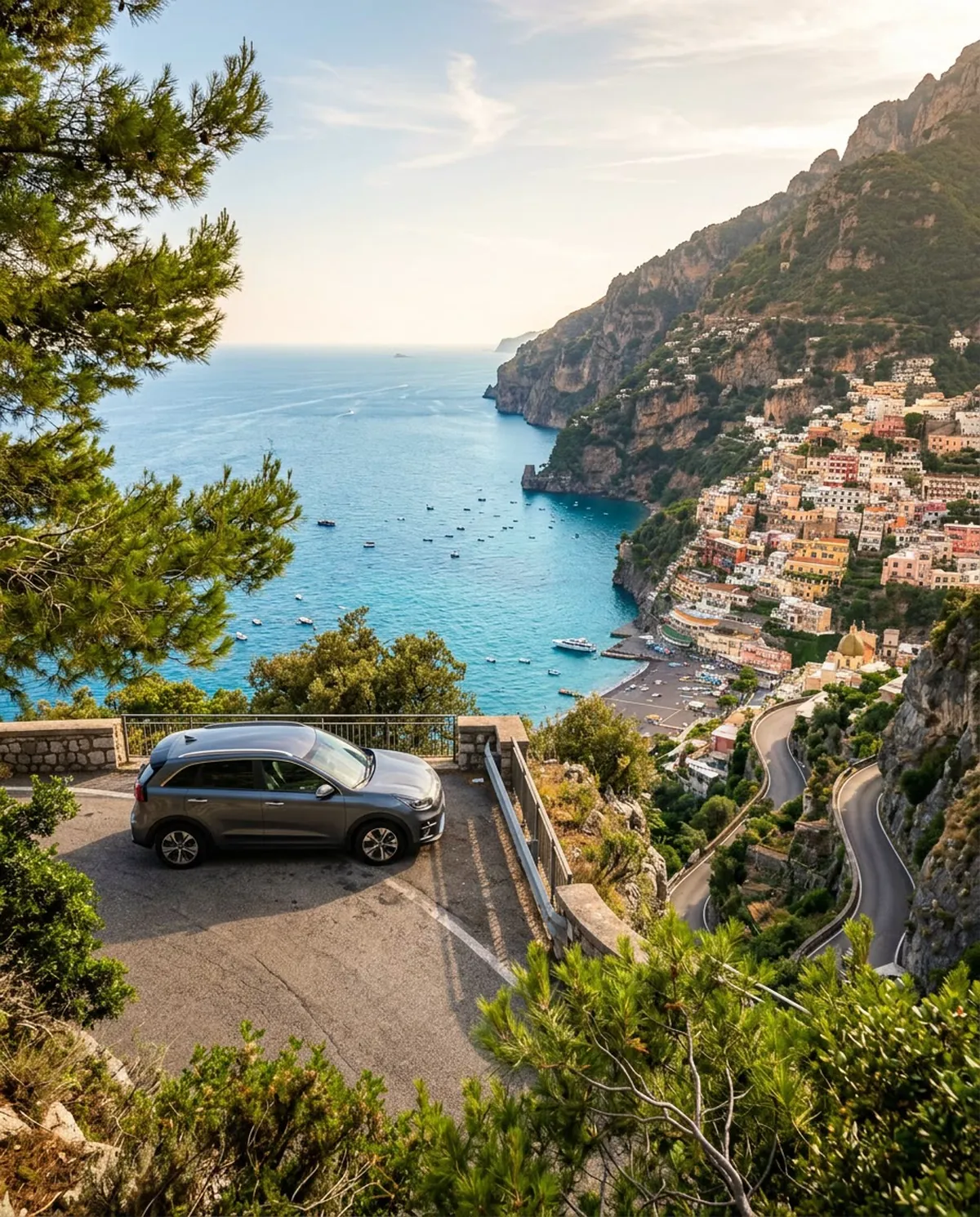
An Amalfi Coast road trip by electric car: five days from Naples to Salerno
Plan an Amalfi Coast road trip by electric car: a 5-day itinerary from Naples to Salerno with charging tips, scenic stops, and parking advice.
Read the article →